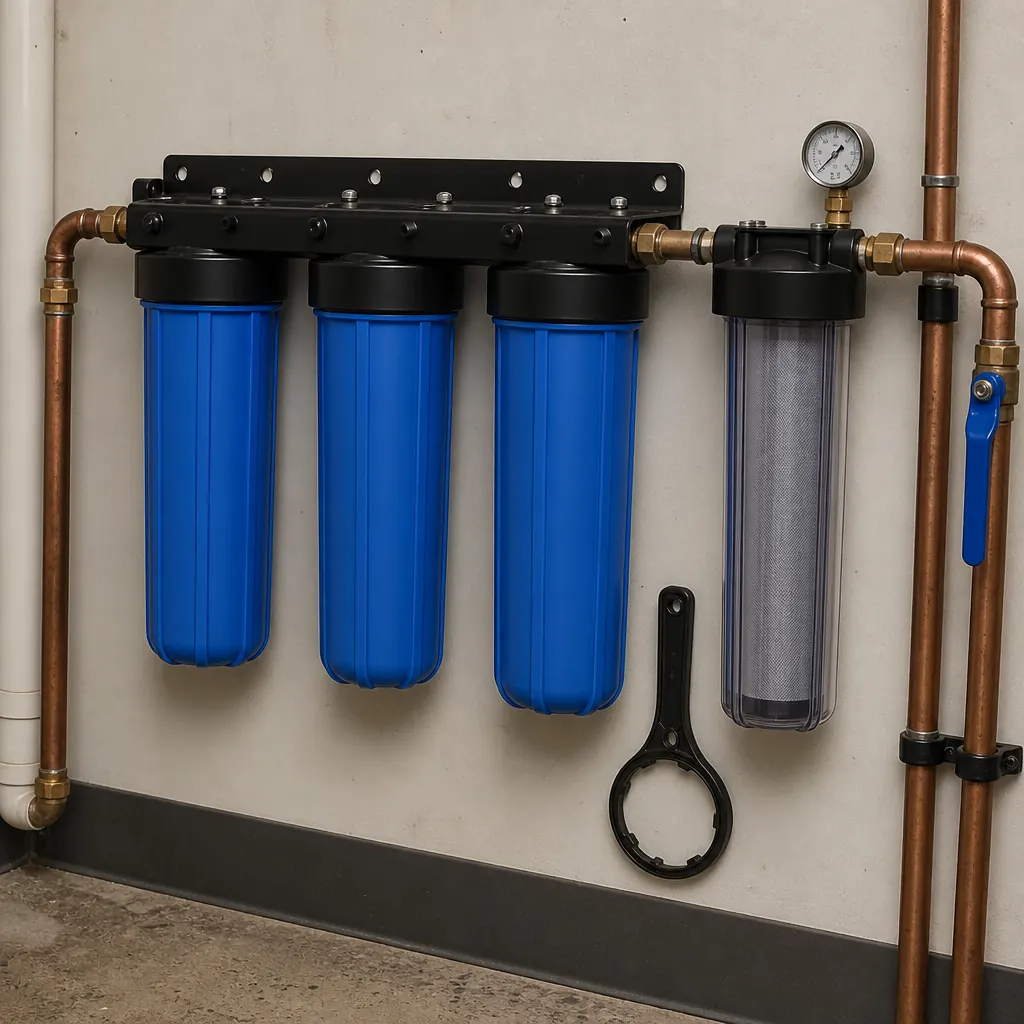
Quick answer: A whole-house filter treats water at the point of entry so every tap benefits — sediment cartridges remove particles, carbon removes chlorine and taste/odor, and specialty media target specific contaminants. But it’s not a softener, and no single unit removes everything. Match the filter to a known contaminant (test first), and pair it with reverse osmosis at the kitchen if you want drinking-water purity.
“Whole-house filter” is a promise that gets oversold. The honest version: these systems are excellent at specific jobs and useless for others. Understanding what they do — and don’t — remove is the difference between solving your water problem and buying an expensive box that does nothing for it. Check the certification: a filter certified to the NSF/ANSI 42 and 53 standards has been independently tested to remove the specific contaminants its label claims, rather than a vague “improves water” marketing promise.
What a whole-house filter actually does
A whole-house (point-of-entry) filter sits on your main water line, treating everything before it branches to faucets, showers, and appliances. The media inside determines what it removes:
- Sediment filters — trap dirt, rust, sand, and suspended particles. Protect downstream equipment and fixtures.
- Activated carbon — removes chlorine, chloramines (with catalytic carbon), taste, odor, and many organic chemicals (VOCs, some pesticides).
- Specialty media — target a specific contaminant: iron/manganese (greensand or oxidizing media), lead (adsorptive media), arsenic, or others.
- Reverse osmosis — the highest purity, but usually applied at a single tap (under-sink), not whole-house, because it’s slow and wastes water.
Notice what’s not on that list: hardness. A standard filter does not remove calcium and magnesium. If scale is your problem, you need a softener — water softener vs salt-free conditioner covers that decision.
Filter vs softener: don’t conflate them
This is the most common confusion, and it’s expensive when gotten wrong:
| Concern | Right tool |
|---|---|
| White scale, spotting, stiff laundry | Water softener |
| Chlorine taste/smell | Carbon filter |
| Dirt, rust, sediment | Sediment filter |
| Specific contaminant (lead, iron, arsenic) | Specialty filter media or RO |
| Want it all, drinking-purity | Whole-house filter + under-sink RO + softener (if hard) |
Filters and softeners are installed in series, not as alternatives. Many homes genuinely need both — but buying a whole-house filter instead of a softener when hardness is the issue is throwing money at the wrong problem.
How to choose the right system
The correct process is test-first, then match:
- Test your water to identify the actual problem. (Best water testing kits) For municipal water, start with your free Consumer Confidence Report.
- Name the contaminant. “My water is bad” isn’t actionable; “my water has 3 ppm iron and a chlorine smell” is.
- Match media to contaminant. One filter, one job, done properly — not a vague “whole-house purifier” that promises everything and delivers little.
- Size flow to your home. Whole-house filters need to pass your peak flow (showers + laundry at once) without pressure drop, so check the flow rating (typically 10–20 GPM for the main line).
Maintenance is real
Whole-house filters aren’t set-and-forget. Sediment and carbon cartridges typically need replacing every 6–12 months depending on water quality and usage. Backwashing media tanks last longer but their media eventually exhausts — usually every 3–10 years. Skip the replacements and the filter stops filtering (and a clogged sediment cartridge can actually restrict flow).
Budget the ongoing cartridge cost before you buy — it’s the part that surprises people.
Our recommendation
- Chlorine taste/odor, municipal water → a whole-house catalytic carbon filter. Straightforward, high-impact.
- Sediment / well turbidity → a sediment pre-filter (often paired with carbon).
- Drinking-water purity → skip whole-house for this one; an under-sink reverse-osmosis unit is cheaper and far more thorough. (Water purification methods explains the technologies.)
- Hardness → that’s a softener, not a filter.
The throughline: identify the contaminant first, then buy the specific tool for it. A whole-house filter is a targeted instrument, not a magic box.
The anatomy of a whole-house system
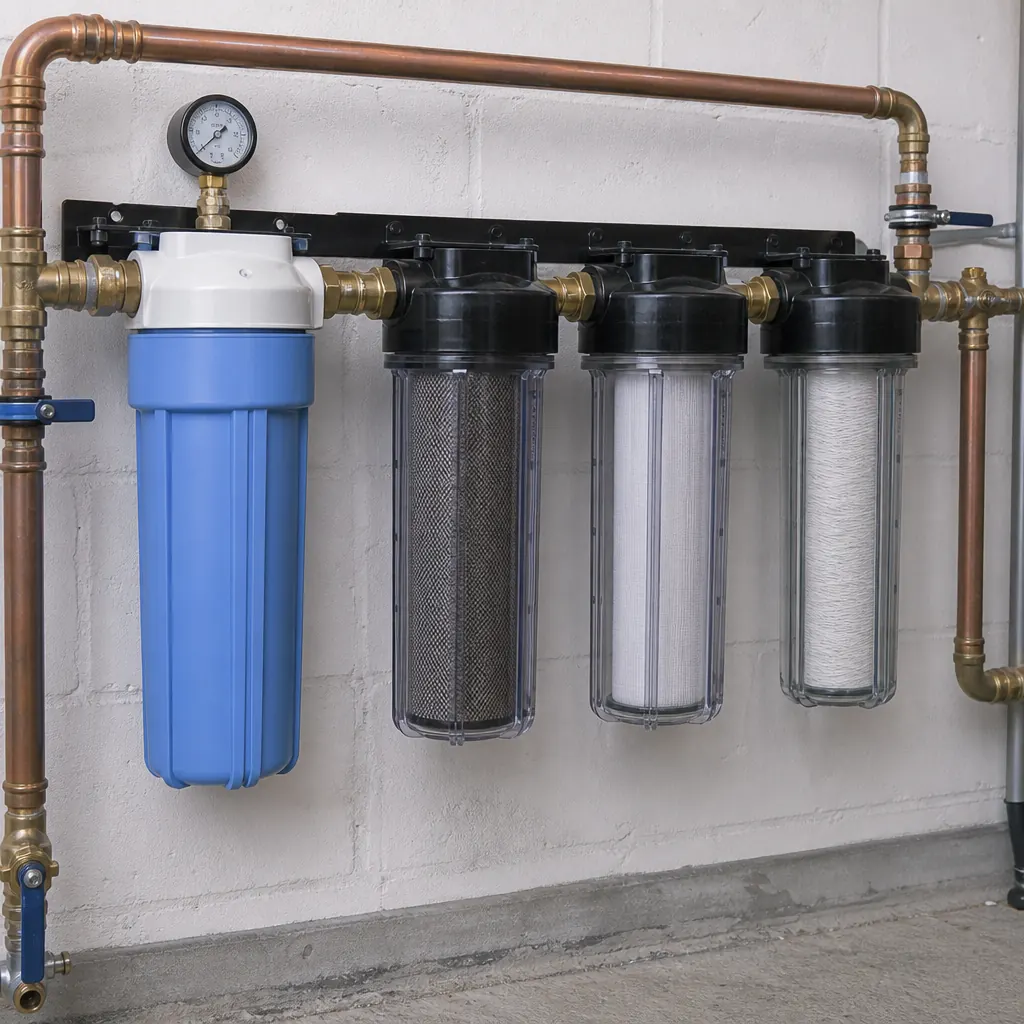
It helps to picture the physical layout, because a “whole-house filter” is usually several stages in a row on your main line:
- Shut-off + bypass — lets you service the filter without cutting water to the house.
- Sediment pre-filter — first line, catching the big stuff so it doesn’t clog or damage the finer stages downstream.
- Main carbon (or specialty) stage — the workhorse, removing chlorine, organics, or your target contaminant.
- (Optional) specialty stage — iron/manganese or lead media where a specific problem exists.
- (Optional) UV or softener — disinfection or hardness, if those are separate needs.
The point: a whole-house filter is a system, not a single cartridge. Understanding the stage order is what lets you diagnose a system that’s underperforming (almost always: the sediment pre-filter is clogged, or a cartridge is overdue).
The flow-rate trap nobody tells you about
Whole-house filters are sized by flow rate (gallons per minute), and this is where people undersize badly. Your filter has to pass your peak simultaneous demand — think two showers, a washing machine, and a dish going all at once — without a noticeable pressure drop.
A spec that looks fine at “5 GPM average” can choke a morning routine that briefly needs 12–15 GPM. The result isn’t cleaner water; it’s weak sh
Filter vs reverse osmosis: where each wins
This is a common source of confusion worth resolving explicitly:
- Whole-house filter — treats all water, at full flow, to a “good enough for everything” standard. Removes sediment, chlorine, and specific macros. It does not produce laboratory-pure water.
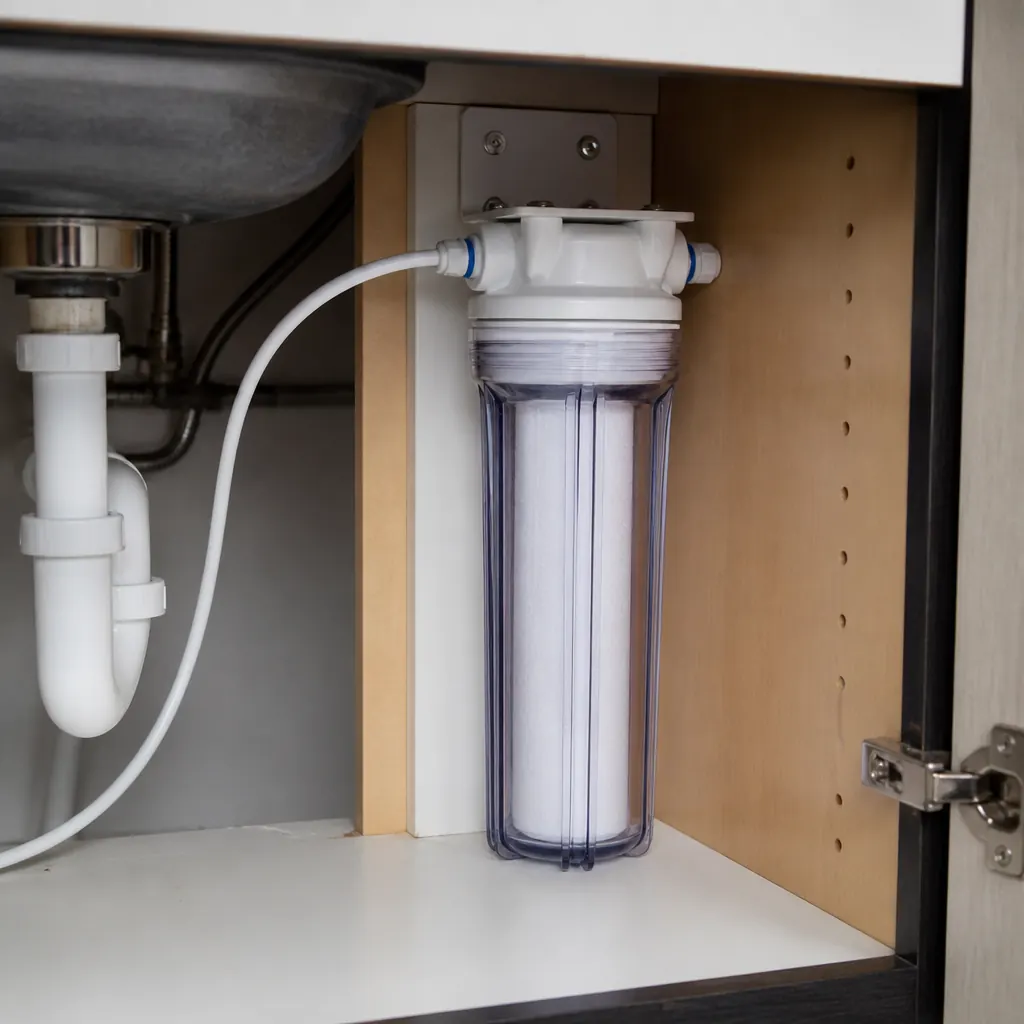
- Reverse osmosis (RO) — treats one tap (under-sink), slowly, to a very high purity. Removes dissolved solids, minerals, and most contaminants the whole-house filter leaves behind.
The correct mental model: whole-house filter for the house, RO for the glass. Drink from the RO tap; wash, shower, and run appliances on whole-house-filtered water. Most serious setups run both, with the RO tap fed from the whole-house filter for maximum filter life.
Installation: DIY or hire
A whole-house filter sits on your main line right after the meter, which means you’re cutting into the primary water supply. The work itself is approachable — a bracket, two connections, a bypass valve, and a housing — and many systems sell as complete kits. A confident DIY-er with basic plumbing skills and push-fit or compression fittings can handle it in an afternoon.
The risk points are exactly where a pro adds value: getting the bypass valve right (so you can service the filter without killing water to the house), making sure the flow direction is correct, and not undersizing the housing for your flow. If you’re at all unsure working on a pressurized main line, the few hundred dollars for a plumber is cheap compared to a fitting failure while you’re away. Decide based on your comfort with the main line, not on the filter’s marketing.
A decision shortcut that never steers you wrong
If the details above blur together, compress them to a single rule: name the contaminant, then match the tool, and treat the house and the glass separately. Whole-house filtration is for the water you use everywhere (sediment, chlorine, the specific contaminant you tested for); under-sink reverse osmosis is for the water you drink; a softener is for hardness. Three different problems, three different tools, often all three installed together.
When a seller tells you one box solves all three, that’s the moment to slow down. The technology doesn’t work that way, and the honest systems that last are the ones built as a matched series, not a single promise.
The four-step decision path in summary
To close this out with something you can act on, here’s the entire buying decision in four steps:
- Test — get a real picture of your water (CCR for municipal, a lab panel for a well).
- Name the contaminant — chlorine? sediment? iron? hardness? lead? Don’t say “bad water”; say exactly what’s there.
- Match the media — carbon for chlorine/chloramine, sediment for particles, specialty media for iron/lead, a softener for hardness.
- Layer as needed — whole-house for the house, RO for the glass.
Run those four steps honestly and you’ll end up with a system that fixes an actual measured problem — which is the difference between water treatment that works and an expensive box that doesn’t do anything you needed.
Bottom line
Carbon, catalytic carbon, and KDF: choosing the right media
Within “carbon filters,” there’s meaningful variety — and it’s the part most buyers gloss over. The three main media types solve different things:
- Standard activated carbon (GAC or carbon block) — removes chlorine, taste, odor, and many organic chemicals. The everyday choice for municipal water. Cannot effectively remove chloramine.
- Catalytic carbon — a specially processed carbon that does remove chloramine (and is more effective on some contaminants like hydrogen sulfide and certain VOCs). If your utility uses chloramine (most now do), this is the media you actually need.
- KDF (copper-zinc media) — a different mechanism that reduces chlorine, heavy metals like lead and mercury, and inhibits bacterial growth inside the housing. Often combined with carbon in higher-end systems.
The practical takeaway is simple: check your CCR for which disinfectant your utility uses. Chlorine → standard carbon is fine. Chloramine → you need catalytic carbon. Skipping this check is how people install a perfectly good carbon filter and still taste chlorine six months later, wondering what went wrong.
Bottom line
A whole-house filter is the right tool when you have a specific, tested contaminant you want removed at every tap — sediment, chlorine, iron, or lead — but it is not a softener and not a universal purifier. Test your water, name the problem, match the media, and pair it with RO at the kitchen if you want drinking-water purity. Tools matched to problems beat expensive all-in-one promises every time.