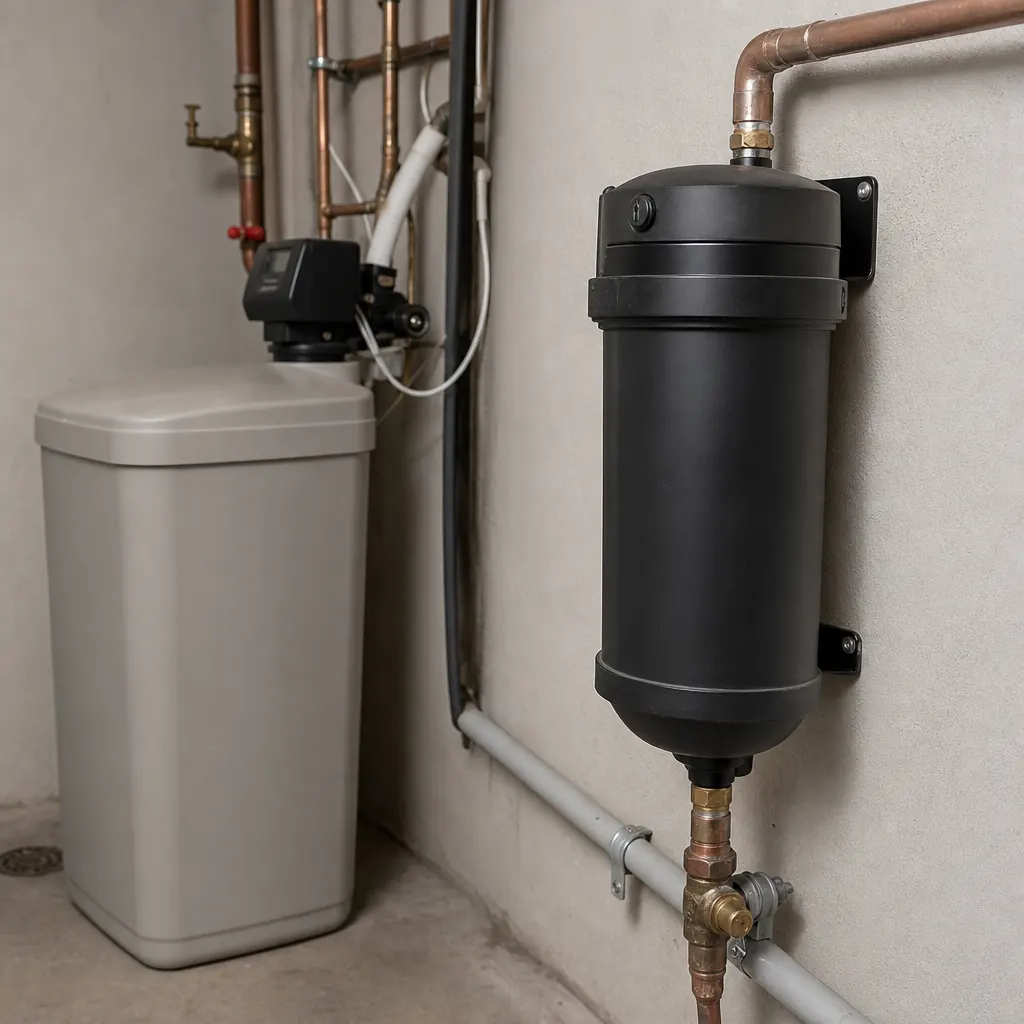
Quick answer: A salt-based softener removes hardness minerals through ion exchange — producing genuinely soft water. A salt-free conditioner changes the minerals so they can’t form scale, but leaves them in the water. For very hard water, go salt-based. For moderate hardness and zero maintenance, a conditioner is often the smarter, simpler choice.
These two are sold as near-interchangeable alternatives, and that conflation is exactly why so many people buy the wrong one. They work differently, produce different results, and suit different situations. Here’s the honest breakdown.
How each actually works
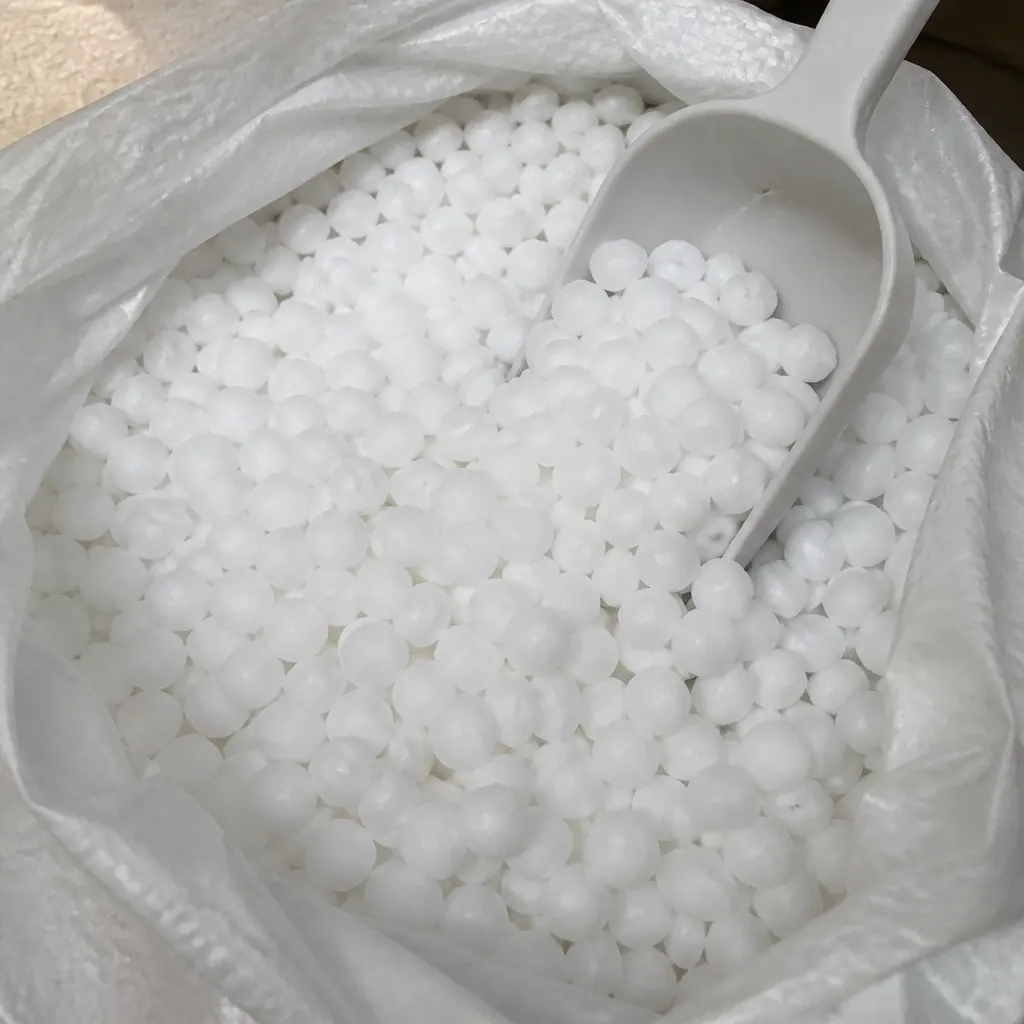
Salt-based softener (ion exchange). Water flows through a resin bed saturated with sodium (or potassium) ions. As hardness minerals pass by, the resin swaps them for sodium — the calcium and magnesium stick to the resin, and sodium goes into your water. Periodically the resin is “regenerated” by flushing it with a strong brine solution that knocks the trapped minerals off and down the drain. Net effect: the hardness minerals are physically removed.
Salt-free conditioner (template-assisted crystallization / TAC). Water passes through a media bed that restructures the calcium and magnesium molecules so they can’t adhere to surfaces and form scale. The minerals stay in the water — they’re just prevented from sticking. No regeneration, no brine, no drain.
This single difference drives everything else.
What you get with each
| Factor | Salt-based softener | Salt-free conditioner |
|---|---|---|
| Removes hardness minerals? | Yes | No (prevents scale) |
| Water feels soft / lathers? | Yes | No (water stays hard) |
| Salt / consumables? | $5–15/month | None |
| Drain line / backwash? | Required | None |
| Electricity? | Usually | None |
| Maintenance? | Add salt monthly-ish | Near zero |
| Adds sodium? | Yes (potassium optional) | No |
| Works on very hard water? | Yes — fully | Partial (scale only) |
When to choose each
Choose a salt-based softener when:
- Your hardness is over ~10 GPG, where you want scale gone, not reduced.
- You want genuinely soft water — for lather, spot-free glass, softer-feeling showers.
- You don’t mind a small amount of added sodium and monthly salt refills.
Choose a salt-free conditioner when:
- Your hardness is moderate (3.5–7 GPG) and the goal is just to stop scale.
- You’re on a septic system (no salt brine into the drain field).
- You want zero maintenance, no salt to carry, no electricity, no drain work.
- Someone in the house is on a sodium-restricted diet.
A useful mental model: a conditioner is a scale inhibitor; a softener is a mineral remover. They’re not the same tool, and the words on the water won’t be the same either.
The honest caveat the marketing glosses over
Salt-free systems are frequently oversold as “softeners without salt.” They are not softeners. Your water will not feel soft, won’t lather dramatically better, and will still read as hard on a test. If your entire reason for buying is “I want soft water,” a conditioner will disappoint you. If your reason is “I want to stop the scale on my fixtures and appliances without dealing with salt,” it’s an excellent fit.
This matters because a lot of people spend conditioner money expecting softener results, then conclude the whole category is a scam. It’s not — it’s just solving a narrower problem than the branding suggests.
Cost and payback
Up front, the two are broadly similar ($500–$2,500 depending on capacity and brand). The real difference is ongoing:
- Salt-based: $5–15/month in salt, forever.
- Salt-free: nothing, beyond an occasional pre-filter swap.
Over a decade that’s roughly $600–$1,800 in salt on the softener side — not enormous, but real. For a home at moderate hardness where a conditioner fully solves the scale problem, the lower long-term cost nudges the decision toward salt-free.
Installation and ongoing effort
The install profiles reinforce the maintenance difference.
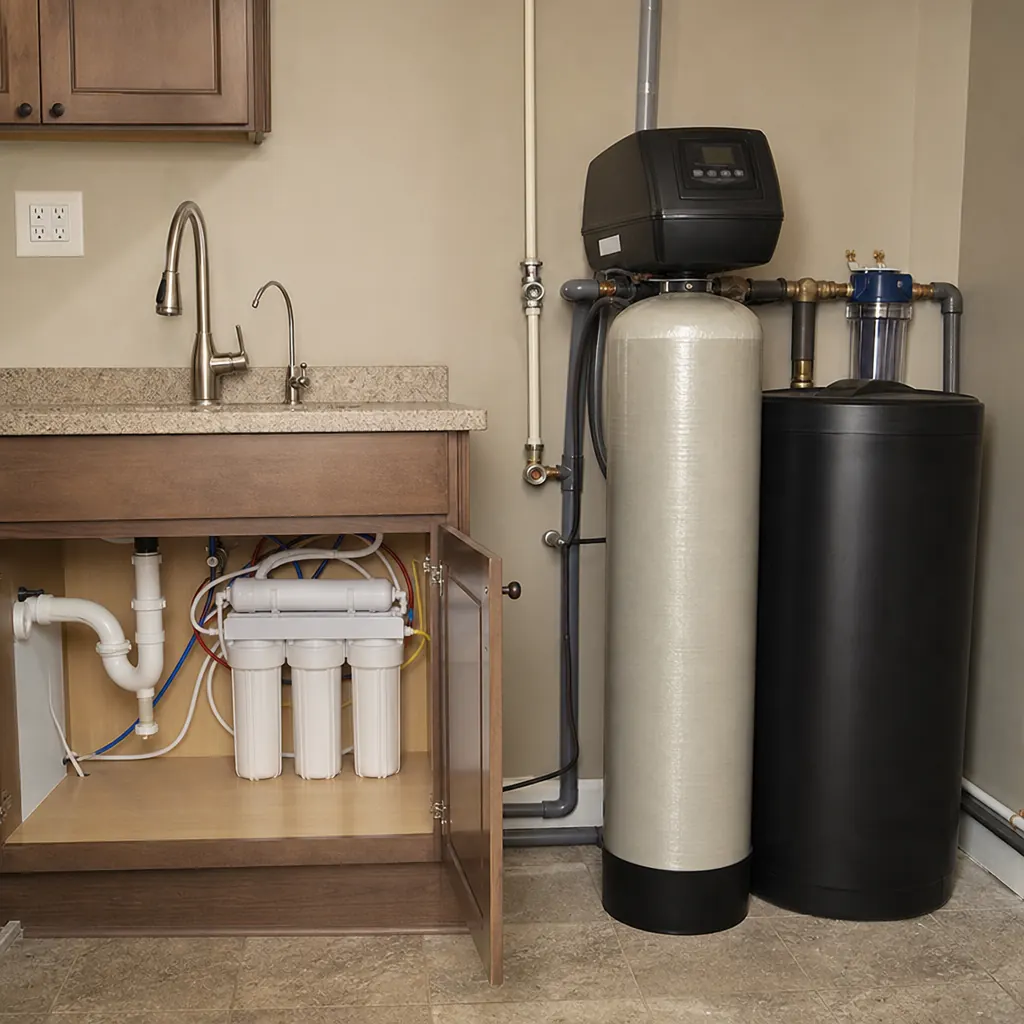
A salt-based softener needs a water inlet and outlet, a drain line for the backwash/regeneration cycle, and a nearby electrical outlet for the control valve. That’s a real plumbing project — either a confident DIY job or a few hundred dollars to a pro — plus an air-gap on the drain to meet code. After install, you’re refilling the brine tank with salt every month or two, and periodically clearing salt bridges (hard crusts that can form and block regeneration).
A salt-free conditioner is dramatically simpler: it splices into the main line with no drain, no power, and no brine tank. The unit itself is often the size of a large cartridge. Maintenance is basically replacing a sediment pre-filter periodically and — on long horizons — the media bed, which can last the life of the unit. If you’re installing in a tight space without a floor drain, a conditioner is far easier to accommodate.
The sodium question, answered honestly
The sodium worry is real but usually overstated. A standard salt-based softener adds sodium to water in proportion to the hardness it removes — typically well under 30 mg per liter even on very hard water, and far less with potassium chloride salt. For comparison, a single slice of bread can contain over 100 mg. The U.S. EPA doesn’t regulate softener sodium, and for most people it’s a non-issue.
That said, two people should think harder about it:
- Anyone on a strict physician-directed sodium restriction — use potassium chloride salt, or soften only the hot-water line and leave cold drinking taps untreated, which is a common, sensible compromise.
- Anyone on a septic system in an area with soil-sensitive discharge — though here the concern is less sodium than the added water/salt load from backwash, which is another point in the salt-free column.
If sodium is the deciding factor, a salt-free conditioner removes it from the equation entirely by not using ion exchange at all.
The environmental lens
Both technologies carry an environmental footprint, just in different places. Salt-based softeners discharge brine during regeneration — which some municipalities restrict, particularly in drought-prone regions where salt in the wastewater stream is a growing concern. A few jurisdictions have even moved to regulate or incentivize against salt-based systems for this reason. Salt-free conditioners generate no brine, no backwash, and no consumable waste, which is why they’re often preferred in water-constrained or environmentally sensitive areas.
The trade-off, again, is effectiveness: a conditioner doesn’t remove the minerals, so on genuinely hard water the environmental argument for salt-free runs up against the practical reality that scale is still forming on your pipes.
Decision checklist
To make this concrete, run through these four questions:
- What’s your GPG? Test it — don’t guess. (How to test your water hardness)
- Do you want soft water, or just no scale? This is the single decision that picks the technology.
Answer those honestly and the choice usually makes itself — without a salesperson involved.
What to do if you’re still unsure
If after all this you’re on the fence, here’s a simple tiebreaker that works better than more research: act on your measured GPG, not on marketing, and default to the cheaper reversible choice.
- If a test puts you at 8 GPG and you’re torn between a softener and a conditioner, buy the conditioner first — it’s cheaper, zero-maintenance, and if six months later you still want genuinely soft water, you’ve learned something specific about what you actually need, and the conditioner either stays as pre-treatment or you sell it.
- If you’re at 12+ GPG, skip the fence-sitting: the physics is unambiguous, and a salt-based softener is the only thing that removes the minerals. The only real question is sizing. (What size softener do you need?)
The goal isn’t a perfect decision made instantly — it’s avoiding the two costly errors: buying a conditioner expecting soft water, or buying a softener for water that was never hard enough to justify it.
A direct feature-by-feature comparison
To make the trade-off concrete, here’s the honest head-to-head:
| Dimension | Salt-based softener | Salt-free conditioner |
|---|---|---|
| Removes hardness minerals | Yes | No |
| Stops scale | Yes | Yes |
| Water feels soft | Yes | No |
| Adds sodium | Yes (potassium optional) | No |
| Salt cost | $5–15/month | None |
| Backwash / drain line | Required | None |
| Electricity | Usually | None |
| Maintenance | Add salt monthly-ish | Near zero |
| Septic-friendly | Generally yes | Ideal |
| Best for | Hard / very hard water | Moderate hardness, scale-only |
The table makes the decision explicit: if you need soft water, only the left column delivers it. If you need no scale with no salt and no maintenance, the right column is the cleaner fit — as long as you understand the water stays hard by measurement.
Bottom line
A deeper look at how TAC actually behaves
Salt-free conditioners market themselves as “no-salt water softeners,” and the confusion is deliberate — so it’s worth understanding precisely what the template-assisted crystallization (TAC) process does inside the media.
In a TAC system, water flows through ceramic or polymer beads whose surface structure acts as a template. As calcium and magnesium ions pass over, the media encourages them to assemble into tiny, harmless micro-crystals that stay suspended in the water and flow on through — rather than clinging to pipe walls, heating elements, and fixtures as scale. The minerals are still in the water (that’s why a test still reads hard), but they’re no longer sticking to anything.
The honest limitation: this scale-inhibition effect is strong for the mineral ions it targets, but it does nothing for already-formed scale, and it does nothing for any other water issue (chlorine, iron, bacteria, dissolved solids). It is a single-purpose device — scale prevention — doing one job well, wrapped in marketing that sometimes wants it to mean more than that.
Understanding this is the difference between buying a TAC system as the right tool for a scale problem and buying it as a “softener” and being disappointed when your water is still hard. The water will still be hard by every measurement; it just won’t form nearly as much scale.
Bottom line
Ask yourself one question: do I want soft water, or do I want to stop scale? Very hard water → salt-based softener, no contest. Moderate hardness + scale-only concern → salt-free conditioner, simpler and cheaper long-term. Match the technology to the goal, not to the marketing label.