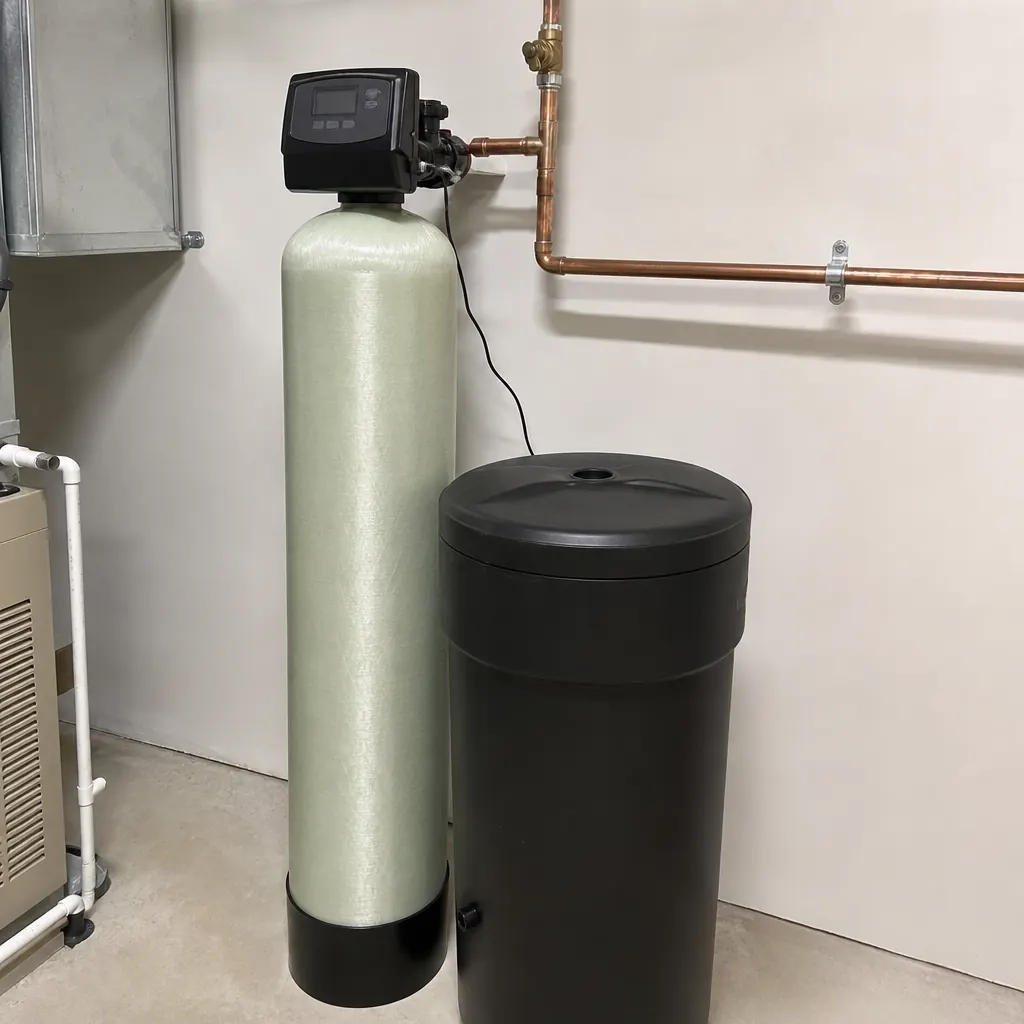
Quick answer: Size a softener with one formula: people × 75 gallons/day × GPG = daily grains demanded. A family of four at 10 GPG needs ~3,000 grains/day, so a 32,000-grain unit (regenerating about weekly) is the right ballpark. Undersizing forces frequent, wasteful regeneration; oversizing wastes money up front.
Buying the wrong-size softener is the most common, most avoidable mistake in water treatment. Here’s the math, done honestly, plus the two secondary factors — iron and flow — that quietly change the answer.
The sizing formula
There’s one equation underneath every sizing chart:
Daily grain demand = people × 75 gallons/day × hardness (GPG)
The 75 gallons is the standard per-person indoor water-use estimate (the Water Quality Association’s standard sizing assumption). Your GPG comes from a test (or your utility’s report). Multiply and you get how much hardness your household puts through the pipes each day.
Worked examples:
| Household | GPG | Daily demand |
|---|---|---|
| 2 people | 8 | 1,200 grains/day |
| 4 people | 10 | 3,000 grains/day |
| 5 people | 15 | 5,625 grains/day |
| 2 people | 20 | 3,000 grains/day |
Matching capacity to regeneration frequency
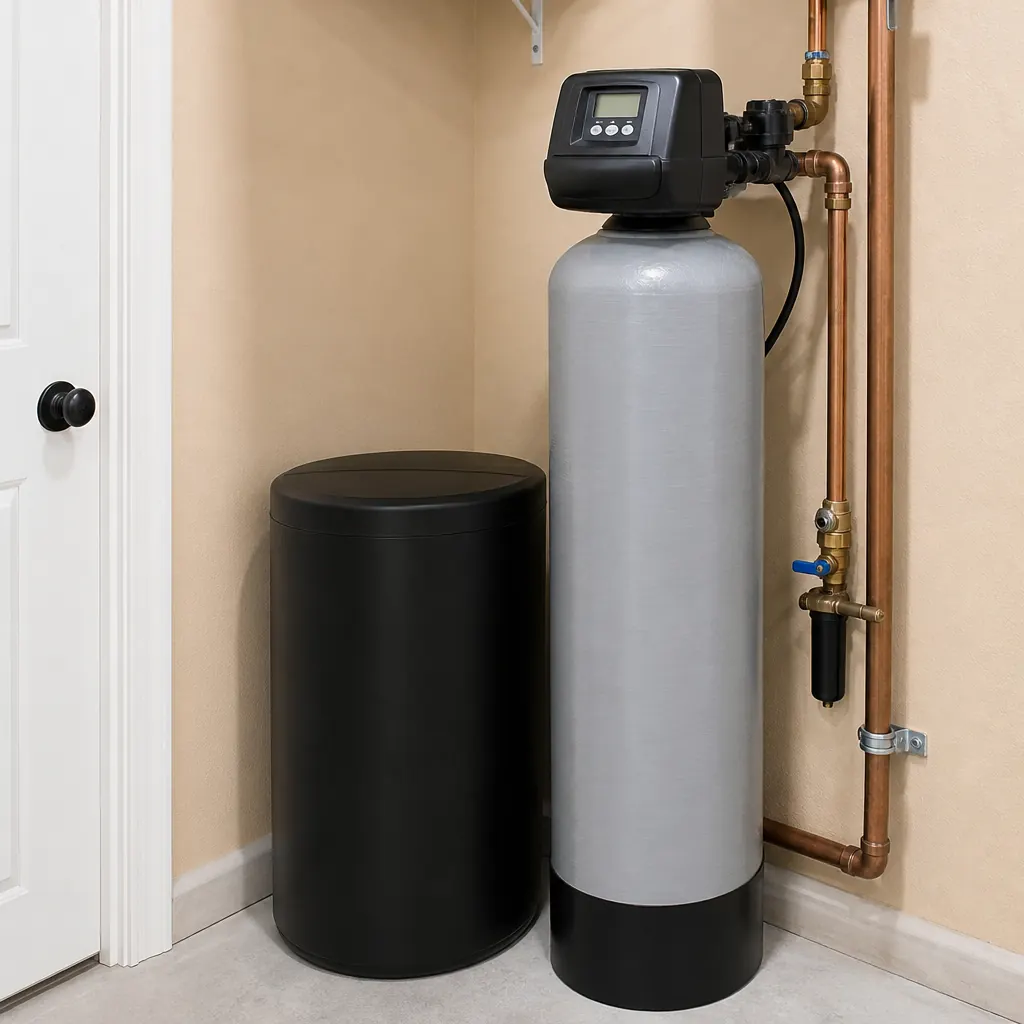
You don’t want a unit that regenerates every night (wastes salt and water) or one that sits for weeks (fouls the resin). The sweet spot is regeneration roughly every 5–7 days.
To hit that, multiply daily demand by your target days, then add a regeneration reserve (commonly ~30%):
- 4 people × 10 GPG = 3,000 grains/day × 7 days = 21,000, plus ~30% reserve ≈ 27,000 → round to a 32,000-grain unit.
- 2 people × 8 GPG = 1,200/day × 7 = 8,400, plus reserve ≈ 11,000 → a 16,000-grain unit is comfortably sized.
- 5 people × 15 GPG = 5,625/day × 7 = 39,375, plus reserve ≈ 51,000 → step up to a 48,000 or 64,000-grain unit.
A 32,000-grain unit is the default for a typical 3–4 person home at moderate-to-hard water. That’s why it’s the most common size sold.
Why “bigger is better” is wrong
Two failure modes, both costly:
- Undersized — the resin exhausts faster than designed, so the unit regenerates too often. You burn through salt and water, and you might get hard water between cycles. This is the worse of the two.
- Oversized — you pay more up front for capacity you don’t use. On some systems, very infrequent regeneration can also let the resin bed sit too long, though modern metered units mitigate this.
The goal isn’t maximum capacity; it’s capacity matched to your demand so regeneration lands in the weekly zone.
The two factors that change the number
Iron. If your water has iron above roughly 1 ppm, it competes with hardness minerals for the resin, effectively consuming capacity. The rule of thumb is to add about 3–5 GPG per 1 ppm of iron to your hardness before sizing — and if iron is a couple ppm or higher, you likely want a dedicated iron filter ahead of the softener rather than just a bigger unit.
Flow rate. Grain capacity is about volume; flow rate
Metered vs timer: the sizing interaction
The regeneration trigger changes how forgiving your sizing is:
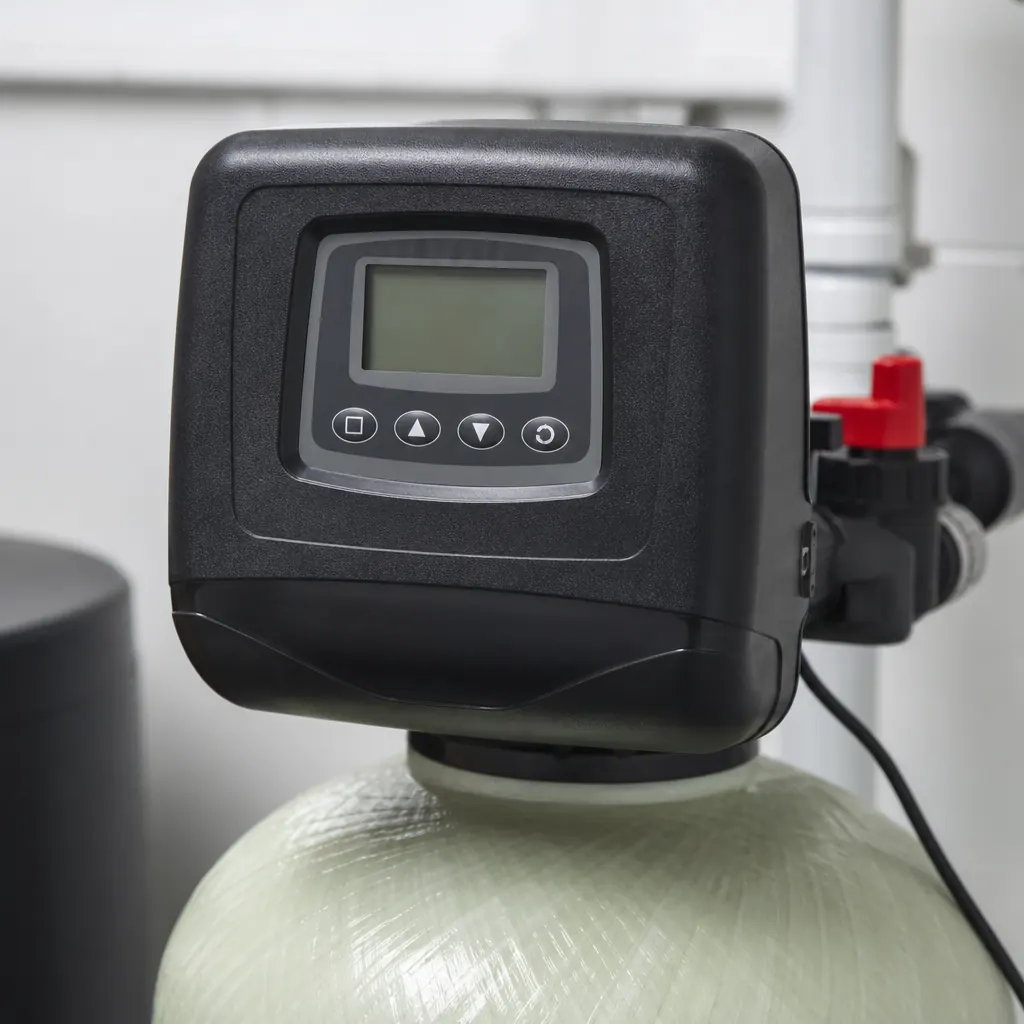
- Metered (on-demand) — measures actual water use and regenerates only when the resin is truly spent. More forgiving of sizing; saves salt and water. Strongly preferred.
- Timer-based — regenerates on a fixed schedule regardless of use. Precise sizing matters more here, because a unit that regens nightly on vacation is still wasting salt.
For most homes, a metered head + the weekly-sized capacity is the right combination.
Getting your GPG before you size
The whole calculation rests on an accurate hardness number. Two free-to-cheap ways to get it:
- Your utility’s Consumer Confidence Report — often lists hardness for your area.
- A test strip or titration kit — gives your actual tap value, which can differ from the city average.
(How to test your water hardness has the full step-by-step.) Never size to a guess or a national “hard water” assumption — that’s how people end up with a 48,000-grain unit in a soft-water city.
The two regeneration metrics that confuse the numbers
When you see a softener spec, two numbers look similar but mean different things, and mixing them up throws your sizing off:
- Grains per pound (or efficiency rating) — how many grains of hardness the unit removes per pound of salt. Higher is more salt-efficient. Common metered units run 3,000–5,000 grains/lb at economy settings.
- Total grain capacity — the headline number (e.g. “32,000 grain”). This is the usable capacity before regeneration, which is always less than the raw resin volume because part of the bed is reserved.
The practical consequence: salt efficiency and grain capacity are a trade-off. Running a unit at its maximum efficiency (higher grains/lb) means a slightly lower effective capacity between regenerations. This is fine — it’s why the 30% reserve in the formula exists. Don’t over-optimize; aim for the weekly regeneration window and the efficiency settles itself.
Sizing examples for real households
To make the math concrete, here are three worked scenarios:
Scenario A — suburban family of four, 10 GPG. Daily demand: 4 × 75 × 10 = 3,000 grains. Target 7-day cycle: 21,000 grains + ~30% reserve ≈ 27,000 → 32,000-grain unit, metered. The default answer for most homes.
Scenario B — young couple in an apartment, 5 GPG. Daily demand: 2 × 75 × 5 = 750 grains. A full 32,000-grain unit would regenerate only once a month — oversized. A 16,000-grain (or even 24,000) unit regenerates comfortably weekly and costs less up front.
Scenario C — large family, very hard well water at 18 GPG + 2 ppm iron. Adjust for iron first: 2 ppm iron ≈ add ~5 GPG → effective ~23 GPG. Daily demand: 6 × 75 × 23 ≈ 10,350 grains/day. That’s a 64,000-grain (or larger) unit — and realistically you’d add a dedicated iron filter ahead of it rather than buying a softener big enough to absorb all that iron.
Notice how scenario C shows the formula and its limit: when iron is significant, the honest answer is often “add an iron filter,” not “buy a bigger softener.”
Common sizing mistakes to avoid
Five errors account for most mis-sized systems:
- Using ppm instead of GPG — always convert (÷ 17.1) before running the formula, or you’ll size 17× too large.
- Ignoring iron — iron eats resin capacity; failing to add 3–5 GPG per ppm under-sizes the unit.
- Sizing to maximum household, not average — the 75 gal/person figure is an average; if you have a second kitchen or heavy outdoor use, bump it up.
- Buying a timer unit without sizing precisely — timer units regenerate on schedule, so exact sizing matters far more than on metered units.
- Forgetting the reserve — raw capacity isn’t usable capacity; always leave the ~30% regeneration buffer.
Avoid those five and your sizing will be in the right ballpark on the first try.
When to hire a sizing professional
The formula covers the vast majority of homes. But a local water-treatment pro earns their fee in a few specific situations:
- Very high iron, manganese, or sulfur — these interact with resin and change the whole treatment train, not just the softener size.
- Complex plumbing or low flow constraints — when peak flow is the binding constraint, a pro can measure it properly.
- You’re combining a softener + filter + RO — the stage order and sizes become interdependent.
A good local pro will also do a real water test and show you the math — if they won’t tell you how they sized the unit, that’s a red flag. The formula above is public; anyone sizing your softener should be able to walk through it.
The one-line summary
Run the formula (people × 75 × GPG), aim for a weekly regeneration, adjust for iron and flow, and prefer a metered head. That single sentence — backed by your actual tested hardness — puts you in the right ballpark without a sizing chart, a salesperson, or a guess. The expensive mistakes all come from skipping it: using ppm instead of GPG, ignoring iron, or buying a unit sized to a number you never actually measured.
How capacity, efficiency, and salt actually interact
When you shop, you’ll see softeners advertised by grain capacity, by salt efficiency, and sometimes by both — and the relationship between the two is the part most buyers never grasp. Here’s the honest version:
- Grain capacity is how much hardness a full resin bed can hold before it needs regeneration. This is the headline number (32,000 grain, 48,000 grain, etc.).
- Salt efficiency (grains per pound) is how efficiently the unit uses salt to regenerate that capacity. A unit can be run in a “high efficiency” mode (more grains per pound of salt) or a “high capacity” mode (max grains between regenerations) — but not both at once.
They trade off against each other. Running a resin bed to its absolute max capacity between regens leaves less salt behind per grain removed — which, counterintuitively, is less salt-efficient. Most modern metered units let you pick a salt setting (typically 6–15 lb per regeneration) that balances the two: lower salt settings save salt but reduce usable capacity between cycles; higher settings maximize capacity but burn more salt.
The practical takeaway: you don’t need to master the efficiency math to size correctly — that’s what the 30% reserve and the weekly-regeneration target are for. But understanding that capacity and efficiency trade off is what prevents you from chasing a “high capacity” spec that secretly costs you more salt every month.
Bottom line
Run the formula: people × 75 × GPG, aim to regenerate weekly, add iron and flow adjustments as needed, and prefer a metered head. A 32,000-grain unit covers the typical 3–4 person home at ~10 GPG. Get your real number first, then size to it — not to a sales pitch.