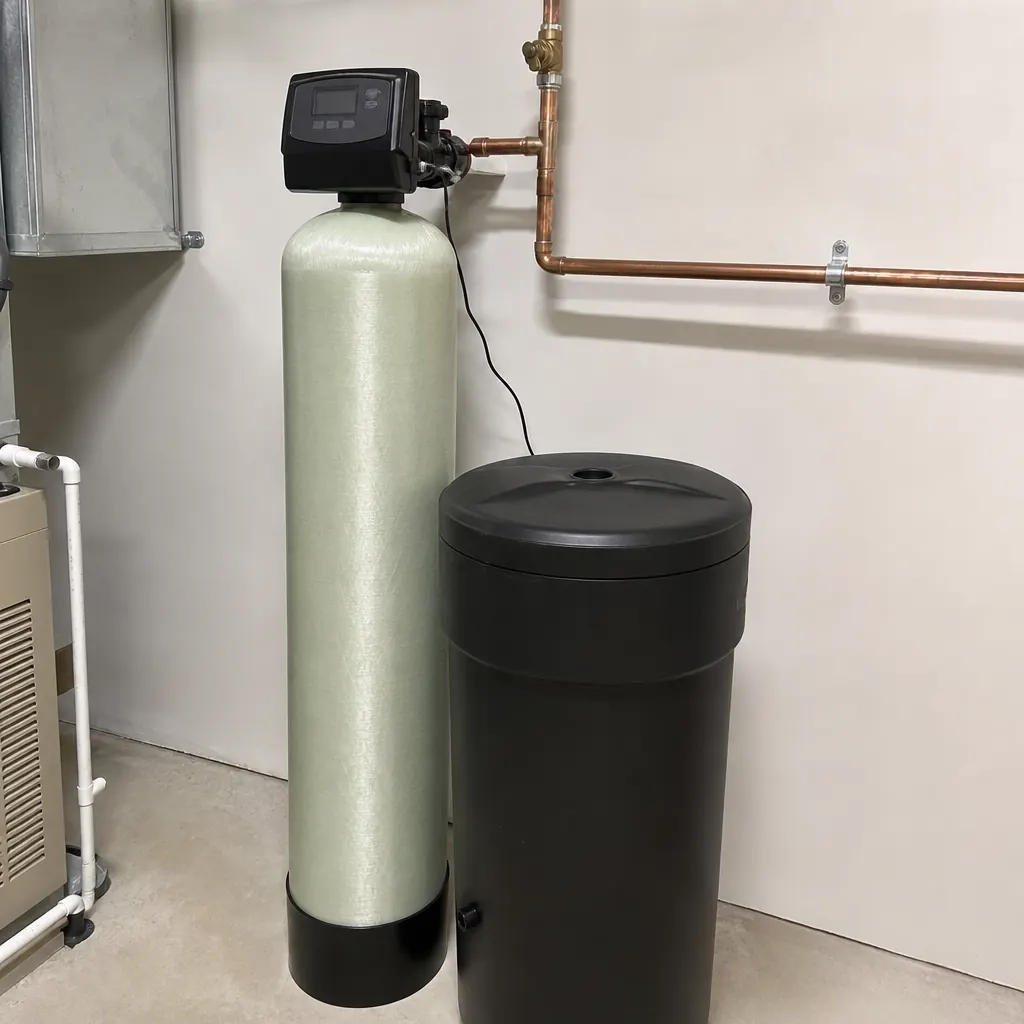
If you’re dealing with hard water — white scale on faucets, spots on glassware that won’t rinse off, stiff laundry, dry skin after a shower — a water softener is the single highest-leverage fix you can make in a home. It doesn’t just make water feel nicer; it protects the appliances that quietly wear out years early on hard water.
Here’s the honest version of how to choose one, what actually matters, and the systems we’d recommend — ranked.
Quick Answer
For most homes with hard or very hard water (over 7 GPG), a salt-based whole-house softener is the best balance of effectiveness and cost. It’s the only class of equipment that genuinely removes hardness minerals. If you’re on a septic system, want zero ongoing maintenance, or just want to stop scale without adding sodium, a salt-free conditioner is the alternative — but understand it reduces scale rather than truly softening the water. Match the grain capacity to your household, and prefer metered (on-demand) regeneration over timer-based.
What hardness actually costs you (so you can size the decision)
The Water Quality Association (WQA) estimates hard water costs the average affected household roughly $800 per year (2010 dollars, ~$1,230 after inflation) across higher energy use, premature appliance wear, and extra cleaning products. That’s the number behind the “does a softener pay for itself?” question.
The mechanism is well documented. The Battelle Memorial Institute found a water heater loses about 4% efficiency for every 5 GPG of hardness (in a 50-gallon-per-day household). The US Department of Energy notes that just a quarter-inch of scale can cause up to 40% efficiency loss. And the Water Quality Association’s detergent studies show soft water needs up to 50% less laundry detergent and up to 70% less dish soap. Add it up and hard water shortens water-heater service life by roughly 30–50%.
None of this is a health issue — the EPA classifies hardness as an aesthetic concern under its Secondary Maximum Contaminant Level, not a regulated hazard. It’s an equipment-and-wallet issue, which is precisely why a softener is a defensible purchase rather than a luxury.
What actually makes a good water softener
Four specs do the heavy lifting. Everything else is marketing noise.
- Grain capacity — this is the number you size to your household. A 32,000-grain unit covers a typical 3–4 person home at 10 GPG. Formula: grains per day = people × 75 gallons × GPG; you want the unit to regenerate roughly once a week, not every night. (See the sizing guide for the full math.)
- Regeneration type — metered (on-demand) beats timer-based. A metered unit measures actual water use and only regenerates when the resin is actually spent, which saves a meaningful amount of salt and water over the life of the unit. Timer units regenerate on a fixed schedule whether they need to or not.
- Resin quality + cross-link % — higher cross-linked resin (8–10%) tolerates municipal chlorine better and lasts longer. This is the part that fails first on the cheapest units.
- Warranty + brand support — the difference between a system that lasts a decade and a boat anchor. A lifetime tank warranty is a real signal; a short parts warranty on the control valve is the weak point.
Our top picks
We researched the major direct-to-consumer and retail brands and ranked them by value, reliability, and whether the recommendation is honest for the hardness you actually have.
1. SpringWell SS Series (salt-based) — best whole-house pick for hard water
If you have genuinely hard water and want actual softening, this is our top recommendation. It uses metered regeneration, comes in 32k–80k grain capacities, uses high-quality 10% cross-linked resin, and carries a lifetime warranty on the tank. It’s the safest default for a home over 8–10 GPG where you want the scale problem gone, not just reduced.
2. Aquasana Rhino (salt-free conditioner) — best for zero-salt, low-maintenance homes
If you specifically don’t want salt, backwash, or a drain line — or you’re on a septic system — a salt-free conditioner is the right call. It prevents scale from adhering to surfaces without ion exchange. The honest caveat: it does not remove the calcium and magnesium, so the water won’t feel soft; it just stops the scale and spotting. This is the correct choice at moderate hardness, not a replacement for a true softener at very-high GPG. (See salt-free vs salt-based for the full trade-off.)
Compare Aquasana salt-free conditioners →
3. US Water Systems (budget / DIY) — best value for self-installers
A strong made-in-USA option with good technical support, which matters if you’re doing the install yourself. Their whole-house filters and softeners sit at a lower price point while still using metered heads and reasonable resin. The trade-off is fewer hand-holding features than the premium brands — a fair exchange if you’re comfortable with basic plumbing.
All three are also available through Amazon if you prefer that purchasing flow: See softeners on Amazon →
Salt-based vs salt-free: pick before you buy
This is the decision that matters more than brand, and most people get it wrong by treating the two as interchangeable.
- Salt-based (ion exchange) physically swaps hardness minerals (calcium and magnesium) for sodium or potassium. It produces genuinely soft water. The downside is the salt, the backwash, and a drain line, plus a small amount of added sodium (trivial for most people, but worth knowing if someone in the house is on a strict sodium-restricted diet).
- Salt-free (conditioner / TAC) changes the minerals so they can’t stick and form scale, but the calcium and magnesium stay in the water. No salt, no backwash, no electricity, near-zero maintenance. The trade-off: your water won’t lather like softened water and won’t feel soft in the shower.
Rule of thumb: over ~10 GPG, get a salt-based softener. At moderate hardness (3.5–7 GPG), a salt-free conditioner is often the better fit and avoids the salt/maintenance entirely. Under 3.5 GPG, you likely don’t need either.
How to install (and whether to hire someone)
For a competent DIY-er, a whole-house softener is one of the more approachable plumbing projects: a water inlet and outlet, a drain line for backwash, and (for salt-based) a nearby power outlet. Many are sold as install-ready kits.
That said, the points where it goes wrong — cutting into your main line, getting the drain air-gap right, and ensuring the bypass valve works — are exactly where a pro earns their fee. If you’re not confident soldering or using push-fit fittings on your main water line, an install (typically a few hundred dollars) is cheap insurance against a basement flood. Most contractors will install a unit you bought yourself for a flat fee.
Know your number before you spend a dime
The most common mistake is buying a softener sized for a hardness level you don’t actually have. Municipal customers can start free: your utility’s annual Consumer Confidence Report (CCR) often lists hardness, and it’s the authoritative source for your service area. If it isn’t listed, or you’re on a private well, test it yourself.
For a quick read, a $10–20 test-strip kit gives you a GPG number in under a minute and is accurate enough to drive the decision. A drop-count titration kit is the next step up in precision if you want an exact number to size equipment. On a well, hardness is only one line — you’ll also want iron, manganese, and bacteria, which is a certified-lab panel, not a strip. Hardness alone doesn’t tell you the whole story on a well; iron especially changes which treatment you need. Once you have your GPG, revisit the sizing math above and match the unit to the real number, not a guess.
What you’ll spend and what it returns
A quality 32,000–48,000-grain salt-based system runs roughly $1,000 installed at the value end, scaling up with capacity and brand. Against a WQA-estimated $800/year in hard-water cost (2010 dollars, ~$1,230 today), a typical hard-water home sees payback in well under two years — and on very hard water (over 15 GPG), often inside a year. The return compounds: every extra year the water heater keeps running at full efficiency is money the softener already earned back.
Maintenance you’ll actually have to do
The honest maintenance picture is light but not zero. A salt-based softener needs its brine tank topped up with salt every month or two — you’ll learn the cadence for your water use within a couple of cycles — and the salt level should be kept above the water line in the brine tank to avoid bridging (hard crusts that block regeneration). Every year or two, a cleaner run through the resin bed keeps it working at full capacity, especially on chlorinated municipal water.
A salt-free conditioner is closer to set-and-forget: no salt, no backwash, and the media often lasts the life of the unit, though the pre-filters (sediment, carbon) need periodic swaps. In both cases, the cheapest thing you can do is protect the unit from freezing if it’s in an unheated basement or crawlspace — a burst unit isn’t covered by warranty and isn’t a cheap fix.
Frequently asked questions
Do I actually need a water softener? Only if your water is hard enough to justify it. Test first — if you’re under ~3.5 GPG, you almost certainly don’t need one. Between 3.5 and 7 GPG, a salt-free conditioner is usually enough. Over 7 GPG, a salt-based softener starts to pay for itself in appliance life and detergent savings.
What size softener do I need? Multiply household size × 75 gallons/day × your GPG to get daily grains, then pick a capacity that regenerates about once a week. A 32,000-grain unit handles a typical 3–4 person home at 10 GPG; step to 48,000 or 64,000 for larger households or harder water. Don’t undersize — an undersized unit regenerates too often and wastes salt.
What’s the difference between a softener and a water filter? They solve different problems. A softener removes hardness minerals (calcium and magnesium). A filter removes contaminants — sediment, chlorine, or specific chemicals. If your concern is contaminants, you want filtration (possibly reverse osmosis), not softening. Many homes need both; they’re not substitutes.
Will a salt-free system actually soften my water? No. It conditions the water to prevent scale, but it does not remove minerals, so the water stays hard by measurement. If you want genuinely soft water (for lather, spot-free glass, and soft-feeling water), you need a salt-based ion-exchange softener.
How much sodium does a softener add to my water? A small amount — typically under 30 mg per liter even for very hard water, and less with potassium-chloride salt. Most people can’t taste it, but if someone in the household is on a sodium-restricted diet, use potassium salt or soften only the hot-water line, leaving the cold drinking taps untreated.
Do I need a professional to install it? No, but it helps. The hookups are straightforward (inlet/outlet, drain, power for salt-based), and DIY kits are common. If you’re not confident working on your main water line, hire someone — the install fee is cheaper than a leak.
Bottom line
For hard water, a salt-based whole-house softener is the highest-ROI upgrade most people never make — it pays for itself in appliance life and detergent, and it’s the only thing that genuinely removes hardness. Pick a metered unit sized to your household, choose salt-free only if you specifically want zero salt/maintenance and don’t mind water that’s still hard, and skip treatment entirely if a test shows you’re under ~3.5 GPG. Test your actual hardness before you spend a dollar.